Control gear quenching distortion link instructions
Gear quenching is the main link in causing distortion. The basic method to control quenching distortion is to cool the parts of the gear as evenly as possible. In addition, there are some noteworthy issues:
1. The influence of the quenching property of the steel itself on the distortion.
The higher the quenability of the steel, the larger the volume involved in the tissue transition. When the workpiece is completely quenched in martensite, the volume difference before and after quenching, the volume change of steel with 1% carbon content is about 1%; if only quenching is half, that is, half of the volume quenching into martensite, then the volume difference before and after quenching will be twice smaller than the former, therefore, the less the quenching ability, the smaller the quenching distortion. Otherwise, the quenching distortion of the gear is the greater.
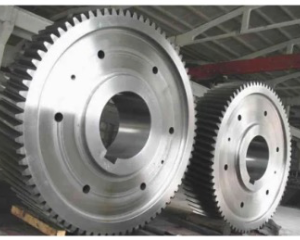
Gear-Ring
In many carburizing gears, in order to solve the distortion problem, the method is often used to reduce the heart hardness. However, from the gear strength, the heart hardness is not too low, because an important reason for many gear fatigue failure is the low heart hardness, so this has become a big contradiction in gear production. In order to solve the contradiction between the gear strength and the heat treatment distortion on the gear core hardness requirements, the quenability of steel must be reasonably limited.
Experiments show that as long as the steel quenching permeability (or heart hardness) is similar, the distortion is also similar, which provides favorable conditions for controlling the distortion. For gear quenching distortion, the quenability of steel is important, but more important is the bandwidth of steel quenability, that is, the fluctuation degree of quenability. It is precisely because of the quenability of steel has the great significance of gear quenching distortion, all countries will incorporate the quenability into the steel standard. In recent years, the width of quenable band has been further narrowed. For example, narrow quenching steel is stipulated in German Technical Conditions for delivery of carburized steel, and its bandwidth is reduced from 8 HRC of ordinary harenable steel to 5 HRC. China's new standard released in 2004 also reduces the width of the quenability band than the original standard.
2. Pressure-forced quenching.
Many domestic gear producers advocate free quenching in concept, in order to simplify the process, facilitate the operation, reduce the cost, and the development of pressure forced quenching process and equipment has been greatly affected. Unfortunately, it is difficult to control the distortion with free quenching. For decades, the distortion of bevel gear has been troubling the gear industry in China. In fact, for the bending distortion of small twist bits and slender rods, pressure straightening is accepted to achieve stable mass production, and for the parts of gear manufacturing and automobile synchronous gear gear, the influence of the production process and heat treatment process under high pressure, which is much lower than the cost of free quenching. Therefore, forced quenching of press should be an important and indispensable process method.
Recently, a molded type induction quenching process has been developed abroad for the quenching of special gear, especially bevel gear and synchronizer gear sleeve, and has achieved obvious results. This new process combines the advantages of induction quenching and die-type quenching, which can greatly reduce the distortion, and can reduce or cancel the subsequent process. Moreover, because the induction quenching adopts water-based coolant quenching, so the gear after heat treatment does not need to be cleaned. At the same time, the built-in sensor can not only heat the quenching, but also can be used to heat the tempering parts without additional equipment, so the production cost is greatly reduced.